Showing posts with label Marathon. Show all posts

Sunday, December 11, 2011

Join in the December 18th Marathon Christmas Bird Count

On December 18, volunteer naturalists will conduct Marathon's annual Christmas Bird Count (CBC). Birders of all skill levels are welcome to help count birds within a 12 km radius of town, which includes the communities of Heron Bay and Pic River. Some parties will range out into the bush on skis and snowshoes while others will stay close to their vehicles, counting birds along the roadsides.

Residents who maintain bird feeders will contribute by keeping a tally sheet of the species visiting their yards. All participants are encouraged to attend a fun and informal chili dinner at 5:30 pm during which bird numbers will be totaled and stories and photos will be shared.

    The CBC is the longest running Citizen Science survey in the world. Data collected by tens of thousands of participants throughout the Americas are used by scientists to help monitor our bird populations. In Canada, the counts are administered by Bird Studies Canada. CBC participants (other than children under 18 and those conducting back yard feeder watches) contribute to Bird Studies Canada a $5.00 fee to help offset the cost of administering the program (details here).


    Marathon Count Circle

    Marathon residents have participated in most years since 1973. Over all years a total of 85 species have been recorded but for each year the average is 25 and no two years are the same. While a handful of common species - Herring Gull, Common Raven, Black-capped Chickadee and European Starling - are seen every year, waterfowl, raptors and winter finches are less predictable. Each year turns up a few surprises. Bald Eagles are now commonly sighted in Marathon throughout the year but they only began appearing on the CBC in 1994 as the continental population rebounded following the implementation of restrictions on the use of organochlorine pesticides.

    Northern Cardinal, a very common species in the south, started appearing on our CBC in the late 1980s reflecting an ongoing northward expansion of its range.


    How to Get Involved
    • Those wishing to participate in this year's CBC should contact Martha Allen at 229-1319 immediately. Martha will assign each person to a team covering a particular section of the count circle. Those conducting feeder watches will be given a tally sheet for birds visiting their back yards.
    • In the morning, each bird counting team will assemble before heading out to count birds in their assigned areas.
    • (Optional) Bird counting teams will meet up with each other at noon at Rumours Coffee House & Deli in the Superior Place Mall (2 Ontario Street) to warm up and trade stories before heading back out for the afternoon.
    • Tally sheets should be dropped off at 8 Steedman Dr. around 5:30 pm. All are welcome to stay for a bowl of chili, a slide show and a draw for a prize donated by the Friends of Pukaskwa.

      Related links:

      Tuesday, July 13, 2010

      Summer Long-tailed Duck

      I came upon this male Long-tailed Duck swimming among recently fledged Herring Gulls on July 13, about a kilometre north of the town boat launch - an area in which we typically see the species in the winter.

      Wednesday, May 5, 2010

      Woodchuck beside the harbour

      Our friend Bill and I came upon a Woodchuck at the mouth of its burrow in an alder thicket beside Peninsula Harbour.
      Woodchuck
      We found a good mix of waterfowl in and near the harbour, most notably Canada Goose, Mallard, American Wigeon, Northern Shoveler, Blue-winged Teal, Green Winged Teal, Ring-necked Duck, Common Goldeneye, Bufflehead & Red-breasted Merganser.
      Ducks on beaver pond
      Warblers were scarce and scattered - Yellow-rumped remain the most numerous. We also saw a few Palm Warblers and a single Orange-crowned Warbler.

      Monday, April 12, 2010

      Something different

      This interesting fellow showed up today .

      (click on photos to enlarge)
      Eurasian Siskin (left) and Pine Siskin (right)


      It took a few minutes and a few field guides to sort him out. Very few Eurasian Siskins have been reported from around the western Great Lakes in the last decade. A quick on-line search turned up these:
      • May 5, 2004 - Whitefish Point, Michigan
      • Apr 14, 2005 - Bay Co., Michigan
      • May 10, 2005 - Red Lake, Ontario
      • Jan 10, 2006 - Iron, Wisconsin.
      I didn't come upon any EUSI reports for Minnesota.

      Julie Craves has documented a "rash" (HT to Darrin) of Old World "cage birds" - European Goldfinch, Chaffinch, European Greenfinch & Great Tit - sightings in our region. These observations increased markedly after 2002 when, it's been alleged,  an importer of cage birds released his stock from a facility north of Chicago. That's only 730 km south of here and thus a very plausible origin for this and other European finches sighted along the north shore of Lake Superior. It may surprise some to learn that feral populations of European Goldfinch and Great Tit are now nesting in Illinois and Wisconsin.

      * * * * * * * * * * * * *

      Some other Old World finch sightings from the north shore

      Last month (March 24, 2010) Ron Lacey photographed this European Goldfinch (south Asian form) at his feeder in Murillo (west of Thunder Bay).
      Courtesy of Ron Lacey.

      A year ago (April 15, 2009), K. Drake photographed a European Goldfinch at his feeder here in Marathon.
      European Goldfinch in Marathon. Photo courtesy of K. Drake.

      Courtesy of Bill Climie, here's a Chaffinch photographed on May 4, 2004 at Silver Islet, on the Sibley Peninsula, east of Thunder Bay.
      Chaffinch at Silver Islet. Photo by Bill Climie.

      A second Chaffinch was seen on May 4, 2009 (five years later, to the day) at the nearby Thunder Cape Bird Observatory.
      Photo by James Barber.

      * * * * * * * * * * * * *

      Request for sightings of other Old World songbirds

      If you know of other occurrences in northwest Ontario of European Goldfinch, Brambling, Chaffinch, Greenfinch, Great Tit, Eurasian Siskin or other Old World songbirds, please contact us through the "comments" button below.


      Related Resources:
      • Craves, J. A. 2008. Current status of European Goldfinch (Carduelis carduelis) in the western Great Lakes region. North American Birds 62:2-5. (PDF)
      • McLaren, I. A., J. Morlan, P. W. Smith, M. Gosselin, and S. F. Bailey. 1989. Eurasian Siskins in North America - distinguishing females from green morph Pine Siskins. American Birds 43:1268-1274. (PDF)
      Acknowdgement:

      • Thanks to K. Drake and Ron Lacey for permission to use their EUGO photos. Visit Ron's photography site here. Thanks also to Bill Climie and James Barber for the use of their Chaffinch photos.

      Wednesday, March 31, 2010

      Another black liquor spill in Peninsula Harbour


      Today we received the troubling news that once again, a toxic spill occurred on the Tembec property in Peninsula Harbour.

      As communicated by Environment Canada:

      On Tuesday March 30th MOE Officers discovered another spill incident at the closed Marathon Pulp mill. This represents the 4th incident in recent months. Foam, odours and discoloured water were observed at the shoreline adjacent to the clarifier on the mill site. The clarifier is believed to contain approximately 100,000 gallons of black liquor (diluted) and is expected to be the source of this incident .

      Both MOE and Environment Canada were on site March 30th reviewing Tembec’s activities to address the 3 previous incidents when this was discovered.

      MOE collected samples and EC planned to collect further samples for toxicity on March 31st. MOE and EC discussed with Tembec actions to undertake immediately. A vacuum truck is now being used to haul the black liquor from the clarifier to the spill basin a few kilometres away. This basin has been the receiving point for material removed from the pipeline and the contaminated groundwater which is being extracted from the beach near chamber #3. Tembec was requested to locate other vacuum trucks for this purpose.
      Here's more from the (April 1st) Thunder Bay Chronicle Journal.

      Sunday, March 21, 2010

      Fewer signs of spring

      Cool, more seasonable weather has settled over the north shore. Birds are on the move but the waves of waterfowl and blackbirds may yet be weeks away. Even so, some changes are evident. Our backyard bird feeders, which have been oh-so-quiet through the last three weeks, were visited today by a pair of Dark-eyed Juncos, a pair of White-throated Sparrows and a pair of Pine Siskins (the first of 2010). At the weedy, over-grown driving range on Penn Lake Rd., we've seen changing numbers - 2, 45, 23, 15 - of Snow Buntings. More will soon follow, accompanied by northward bound Horned Larks and Lapland Longspurs. The Gray-crowned Rosy-Finch has not been seen since March 13.Snow Buntings beside Penn Lake Road.

      Thursday, March 11, 2010

      Gray-crowned Rosy-Finch update

      The prospects for out-of-town Rosy-Finch seekers are improving. After almost a month of invisibility, the bird was re-sighted this past Monday (March 8) in the vacant lot, known locally as the driving range, across from the landfill site on Penn Lake Rd E.

      I found the bird again this afternoon in the same place, this time in the company of two, rather than three, Snow Buntings. I was able to get some photos and a short video clip. Several other local birders saw the bird an hour or so later.

      Click on photos to enlarge.


      The green arrow marks the spot:

      View Larger Map

      Monday, March 1, 2010

      Winter birding round-up

      The passing of February marks the end of the winter birding period. A total of 53 species were observed in the Marathon area. This compares to 191 species recorded for the province over the same span of time.

      A few rarities turned up. Two Townsend's Solitaires were tallied in December. An Eastern Towhee overwintered at a feeder in Heron Bay while a second was reported once from a feeder in Marathon in late February. Bird feeders in Marathon supported a Fox Sparrow, a White-throated Sparrow and several Northern Cardinals through the reporting period. Late dates were recorded for Ring-necked Duck (Dec 20), American Coot (Dec 15), Gray Catbird (Dec 6) and Chipping Sparrow (Dec 21). A Gray-crowned Rosy Finch was photographed as it consorted with three Snow Buntings at the Penn Lake Road landfill site on Feb 12. The bird couldn't be relocated over subsequent weeks.

      Speaking of bird feeders, many people noted that overall activity was low. An abundant crop of Mountain Ash fruit, here and throughout the boreal forest, may account for the abundance of overwintering American Robins in the area and the infrequency of Pine Grosbeaks at feeders. Among the birds I observed foraging on Mountain Ash were Ruffed Grouse, European Starling, Bohemian Waxwing, Common Raven, American Crow, Black-capped Chickadee and Pine Grosbeak.
      Pine Grosbeak feeding on Mountain Ash, Feb 12.
      We are among many who have not once refilled our niger seed feeders this winter. Only a few American Goldfinches were observed and Pine Siskins were absent. Several flocks of Common Redpolls were seen foraging on Tamarack and Alder seeds, far from feeders.

      Many thanks to those people, listed below, who shared their observations. Any errors are mine.


      Bird Sightings, Dec 1, 2009 - Feb 28, 2010

      • American Black Duck: 6, Steel R., Dec.2 (MB).
      • Ring-necked Duck: 1 male, Marathon Harbour, Dec. 8, 10, 17 (MB), 20 (CBC).
      • Common Goldeneye: up to 20 observed on more than 10 dates in Marathon Harbour, Dec 6 - Feb 27 (CBC, MB), pair at LaFarge cement plant Dec 20 (CBC) and Feb 27 (MB); single at Umbata Hydro GS, Jan 30 (MA, MB).
      • Long-tailed Duck: 7 at Marathon Harbour Dec 20 (CBC); 21 at Marathon Harbour, Jan 21 (MB).
      • Ruffed Grouse: up to 2 observed on more than 10 dates throughout the region, Dec 20 - Feb 28 (MB, MA, CBC).
      • Spruce Grouse: 1 at Neys P.P., Jan 22 (MA and MB); 1 at mouth of Pic R., Feb 21 (MB); 1 at Angler Cr., Feb 20 (NE, BM).
      Spruce Grouse at mouth of Pic R., Feb 21 (MB)
      • Bald Eagle: singles and Penn Rd landfill site Dec 1, 17, 20 (MB, BC, CBC); Heron Bay Landfill Dec 17 (MB, BC). None observed following the Dec 20 CBC.
      • Northern Goshawk: 1 (ad.) on Dead Horse Creek Rd., Jan 8 (MB); 1 (imm.) at Pukaskwa N.P., Feb 28 (MA and MB).
      • Sharp-shinned Hawk: 1 seen in Marathon, Jan 30 (JL).
      Sharp-shinned Hawk in Marathon, Jan 30 - Photo by Jim Lowndes
      • Red-tailed Hawk: 1 in Marathon Dec 20 (CBC).
      • American Coot: 1 in Marathon Harbour Dec 5, 6, 8, 10, 15 (MA, MB, BC).
      • Herring Gull: up to 300 individuals seen on more than 10 dates, most abundantly at the Penn Lake Rd. landfill site, Dec 1 - Feb 28 (MB, MA, CBC).
      • Glaucous Gull: 1 or 2 seen with Herring Gulls at Penn Lake Rd. landfill site or in Marathon Harbour on more than 10 dates, Dec 18 - Feb 27 (MB, CBC).
      • Rock Pigeon: up to 6 seen at LaFarge docking facility, NW of the Pic R., Dec 17, Jan 13, Feb 21 (BC, MB).
      • Mourning Dove: up to 25 seen near feeders on Steedham Dr. and Sund Cr. in Marathon on more than 10 dates, Dec 17 - Feb 25; 7 at feeder in Heron Bay on Dec 20 (CBC).
      • Northern Hawk Owl: 1 seen on Bamoos Cr., Feb 7 (C&KD).
      • Barred Owl: 1 at Marathon Cemetery, Dec 6 (WM); 1 at Angler Cr. Dec 20 (CBC).
      • Downy Woodpecker: up to 23 observed on more than 10 dates throughout region, Dec 1- Feb 28 (MB, MA, BC, NP, CBC).
      • Hairy Woodpecker: 1 observed at Pukaskwa N.P. Dec 18 (WM); 1 in Marathon Jan 4 (MB); 5 in Marthon, Dec 20 (CBC).
      • American Three-toed Woodpecker: singles seen at Pukaskwa N.P. Dec 11 (MB), Dec 20 (CBC), Feb 15 (MB); 2 at Pukaskwa N.P. Feb 21; 1 seen in Marathon Dec 20 (CBC).
      • Black-backed Woodpecker: 1 on Hawks Ridge Trail in Marathon Dec 20 (CBC); 1 at Heron Bay Feb 20 (MB, NE, BM).
      • Pileated Woodpecker: 1 seen/heard in Marathon Dec 1 (MB), 20 (CBC), Feb 15, 16, 18 (MB); 1 at Heron Bay on Feb 20 (MB); 1 on Deadhorse Creek Rd. on Jan 6 (MB);2 on Deadhorse Creek Rd., Jan 8 (MB).
      • Northern Shrike: 1 at Pukaskwa N.P. Dec 15, 18 (WM); 1 on Dead Horse Creek Rd., Jan 6 (MB).
      • Gray Jay: up to 20 seen on more than 10 dates throughout region, Dec 2 - Feb 28 (MB, MA, CBC).
      • Blue Jay: up to 9 seen on more than 10 dates throughout region, Dec 10 - Feb 27 (MB, CBC, NE, BM).
      • American Crow: up to 14 seen on more than 10 dates, primarily in Marathon and Heron Bay, Dec 1 - Feb 28 (MB, MA, CBC).
      • Common Raven: up to 245 observed on more than 10 dates throughout the region, most abundantly at Penn Lake Rd. and Heron Bay landfill sites, Dec 1- Feb 28 (MB, MA, CBC).
      • Black-capped Chickadee: up to 187 seen on more than 10 dates throughout region, Dec 1 - Feb 28 (MB, MA, CBC).
      • Boreal Chickadee: up to 6 observed on more than 10 dates throughout region, Dec 11 - Feb 28 (MB, MA, NP, CBC).
      • Red-breasted Nuthatch: up to 29 observed on more than 10 dates throughout region, Dec 6 - Feb 28 (MB, MA, CBC).
      • White-breasted Nuthatch: 1 at feeder on Sund Cr., Dec 17 (MB and BC), Dec 20 (CBC).
      • Brown Creeper: 1 in Marathon, Dec 20 (CBC).

      Townsend's Solitaire at Pic River, Dec 10 (MB).
      • Townsend's Solitaire: 1 at Pic R., Dec 10 (MB); 1 at Angler Cr., Dec 20 (CBC).
      • American Robin: up to 20 seen on more than 10 dates throughout the region, Dec 7 - Feb 28 (MB, MA, CBC).
      • Gray Catbird: 1 at Feeder on Sund Cr., Marathon, Dec 6 (MB and BC).
      Gray Catbird visiting feeder in Marathon, Dec 6 (MB)
      • European Starling: up to 96 in Marathon and up to 4 in Heron Bay on more than 10 dates, Dec 1 - Feb 28 (MB, MA, BC, NP, CBC).
      • Bohemian Waxwing: 5 at Pic R., Dec 16 (MB), 50 at Pic R. Dec 17 (MB, BC), 20 on Dead Horse Creek Rd., Jan 6 (MB); 50 near Marathon Airport, Feb 8 (MB).
      • Eastern Towhee: 1 male at feeder in Heron Bay, Dec 11, 20, Feb 20 (NE, BM), 27 (MB); 1 male at feeder on Nicolet St., Feb 6 (MS).
      This furtive Eastern Towhee, seen here on Feb 27, overwintered at a feeder in Heron Bay (MB)
      • American Tree Sparrow: 1 at feeder on Manitoba St., Feb 24 (MB).
      • Chipping Sparrow: 1 photographed and observed on more than 10 dates, daily at feeder on Manitoba St., Dec 2-21 (MA, MB).
      • Fox Sparrow: 1 photographed and observed on more than 10 dates, daily at feeder on Manitoba St., Dec 2 - Feb 28 (MB, MA).
      • White-throated Sparrow: 1 photographed and observed on more than 10 dates, daily at feeder on Manitoba St., Dec 2 - Feb 28 (MB, MA); 1 struck window at Pukaskwa N.P., Dec 8 (MA, WM) .
      Northern Cardinal, Chipping, Fox and White-throated Sparrows, Dec 9 (MB)
      • Dark-eyed Junco: up to 11 observed on more than 10 dates and feeders in Marathon and Heron Bay, Dec 1 - Feb 28 (MA, MB, CBC).
      • Snow Bunting: 1 on Stevens Ave, Marathon, Dec 1 (MB); 5 in Marathon Dec 20 (CBC); 3 at Penn Rd. landfill site, Marathon, Feb 12 (MB), 1 near Jellicoe Cove Feb 20 (BM, NE).
      • Northern Cardinal: up to 3 seen at feeders on Sund Cr. and Manitoba St., Marathon, on more than 10 dates, Dec 1 - Feb 28 (MA, MB, C&MB, CBC)
      • Common Grackle: 1 on trail off Hemlo Dr., Marathon, Feb 14, 28 (NP).
      Gray-crowned Rosy-Finch at Marathon landfill site, Feb 12 (MB)

      • Gray-crowned Rosy-Finch: 1 photographed at Penn Lake Rd. landfill site, Marathon on Feb 12 (MB).
      • Pine Grosbeak: up to 40 seen throughout region on more than 10 dates, Dec 10 - Feb 27 (MA, MB, NP, CBC).
      • Red Crossbill: 2 seen on along Angler Cr. Dec. 20 (CBC).
      • White-winged Crossbill: 6 along Angler Cr. on Dec 20 (CBC); 30 at Prairie R. mouth Feb 5 (MB).
      • Common Redpoll: 2 at Marathon Dec 20 (CBC); 20 at Heron Bay, Feb 6 (MB); 20 at Pukaskwa N.P. Feb 27 (MB).
      Common Redpolls at Pukaskwa N.P., Feb 27 (MB)
      • American Goldfinch: 1 at feeder on Sund Cr., Dec 17 (MB, BC) 2 at Marathon Dec 20 (CBC); 1 at feeder on Manitoba St., Marathon on Feb 9 (MB).
      • Evening Grosbeak: up to 36 observed on more than 10 dates, mostly at feeders in Heron Bay and Marathon, Dec 7 - Feb 21 (MB, MA, WM, CBC).

      Observers: Martha Allen (MA); Michael Butler (MB); Monique and Clarence Bérubé (M&CB); Bill Climie (BC); Christine and Kyle Drake (C&KD); Nick Escott (NE); Jim Lowndes (JL), Wayne Michano (WM); Brian Moore (BM); Nolan Pelland (NP); Mike Small (MS); Christmas Bird Count (CBC).

      Monday, February 15, 2010

      Voyageur Hiking Trail at Marathon

      The Voyaguer Hiking Trail runs, somewhat intermittently, from Thunder Bay, east to Manitoulin Island. There is a short (2.1 km) section which crosses the coast from the Town of Marathon, north to Sturdee Cove.


      Friday, February 12, 2010

      Gray-crowned Rosy-Finch

      During the December 20th Marathon CBC, Martha and I drove a loop around the inside perimeter of the landfill site under the watchful eye of the town employee with whom we'd prearranged access to the facility. We had hoped to catch a few hundred gulls napping but our timing was off (we later learned they were on the wing closer to the big lake). Instead we counted ravens, lots of ravens.

      As we approached the gate to leave the site, three Snow Buntings and one darker bird flew past. We tallied the SNBU's but had to leave the fourth bird unidentified. We figured it was either a Horned Lark or a Lapland Longspur - common associates of Snow Buntings. Indeed, during the 2008 CBC, we found one of each species only a few metres from this spot.

      Today as I passed the landfill site on Penn Lake Rd, I again watched three Snow Buntings and a darker associate fly alongside the road. Fortunately, the flock landed and began feeding on the seed heads of grasses in a low-lying spot. I pulled over and approached on foot. The fourth bird was very dark indeed. I was able to get close enough to see clearly that this was neither a Lapland Longspur nor a Horned Lark...

      And so I'm left wondering if this was the same dark little bird we didn't ID during the CBC, a month and a half ago.

      Click on photos to enlarge.


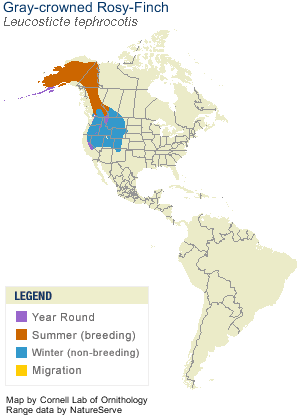
      Gray-crowned Rosy-Finches do occasionally stray from the Rockies into Ontario, although infrequently enough that the species is on the rare birds review list for northern Ontario.


      Those interested in seeing this bird should know that the landfill site is out-of-bounds to the public - unconsolidated fill presents a serious risk to trespassers. Fortunately the southwest-facing slope can be scanned from the shoulder of Penn Lake Road. I recommend bringing a spotting scope. The vacant lot on the south side of Penn Lake Rd, across from the dump, holds decent looking field habitat that can be more thoroughly searched on foot. Those contemplating a trip from out-of-town should bear in mind that this particular Rosy-Finch is not visiting a feeder and thus its whereabouts are unpredictable.


      Range map from the Cornell Lab of Ornithology.


      Update - March 8, 2010

      After checking the open areas on both sides of Penn Lake Rd. on most days since the bird was first sighted on Feb 12, I relocated the three Snow Buntings and the Gray-crowned Rosy-Finch this evening at around 5:30 pm in the weedy vacant lot across the road from the landfill site. The spot (48.72429, -86.37399) is about 150 metres west of where the birds were seen on Feb 12. As before, the birds were actively feeding on the seed heads of grasses and evening primrose.

      Sunday, February 7, 2010

      Northern Hawk Owl near Marathon

      Photo by Christine Drake
      Christine and Kyle Drake ran into this Hawk Owl while trekking up a frozen Bamoos Creek, toward Bamoos Lake, just northwest of Marathon today.

      Tuesday, January 5, 2010

      Nothern Cardinal

      This Northern Cardinal is a regular at our feeder. It was one of three tallied on the Christmas Bird Count.
      Click to enlarge

      Monday, December 28, 2009

      Marathon CBC summary


      On Sunday, December 20 about twenty five birders fanned out over the Marathon - Pic River - Heron Bay area during a very productive and enjoyable Christmas Bird Count. This was the 33rd year Marathon has participated in this international Citizen Science project since 1958.

      The limited snow cover enabled bird-counting parties to access the bush without snowshoes or skis. On a trek to Sturdee Cove, Nick Escott and Brian Moore crossed paths with a Barred Owl (a count first) and a Townsend's Solitaire, a Rocky Mountain species which rarely strays into Ontario in the winter. On Hawk’s Ridge, Kyle and Christine Drake were rewarded with a Black-backed Woodpecker.


      Thanks to the efforts of backyard feeder watchers, White-breasted Nuthatch, Northern Cardinal, Fox Sparrow and Eastern Towhee were tallied.


      Some of the numbers
      • 38 species seen on count day (average 25.1, highest was 40 species in 2001)
      • total individuals: 1139 (average 1035)
      • high counts: Mourning Dove (33) (prev high 27 in 2007); Blue Jay (9) (prev high 5 in 2005)
      • Two new species for Count Day: Ring-necked Duck (1) and Barred Owl (1)
      • Townsend's Solitaire - 2nd ever for count (first in 1988)
      • Eastern Towhee (a single bird for the 6th year)
      • Fox Sparrow - 2nd ever for count (first in 2007)
      • Chipping Sparrow - new species for count week
      Special thanks to The Friends of Pukaskwa for donating a bird field guide
      and the Pukaskwa NP anniversary pins and to Laura Lea Comeau for donating a beautiful Gray Jay print and calendar.


      Count totals:
      Ring-necked Duck 1 (new to count)
      Long-tailed Duck 7
      Common Goldeneye 6
      Ruffed Grouse 3
      Bald Eagle 2
      Red-tailed Hawk 1
      Herring Gull 300
      Glaucous Gull 2
      Rock Pigeon (6CW)
      Mourning Dove 33 (HC)
      Barred Owl 1 (new to count)
      Downy Woodpecker 23
      Hairy Woodpecker 5
      American Three-toed Woodpecker 2
      Black-backed Woodpecker 1
      Pileated Woodpecker 1
      Northern Shrike (1CW)
      Gray Jay 20
      Blue Jay 9 (HC)
      American Crow 14
      Common Raven 245
      Black-capped Chickadee 187
      Boreal Chickadee 4
      Red-breasted Nuthatch 29
      White-breasted Nuthatch 1
      Brown Creeper 1
      Townsend's Solitaire 1
      American Robin 20
      European Starling 96
      Bohemian Waxwing (50CW)
      waxwing sp 14
      Eastern Towhee 1
      Chipping Sparrow (1CW)
      Fox Sparrow 1
      White-throated Sparrow (1CW)
      Dark-eyed Junco 11
      Snow Bunting 5
      Northern Cardinal 3
      blackbird sp 1
      Pine Grosbeak 40
      Red Crossbill 2
      White-winged Crossbill 6
      Common Redpoll 2
      American Goldfinch 2
      Evening Grosbeak 36
      ______________
      (CW)=seen in count week; (HC)=high count

      Friday, December 18, 2009

      Count week sightings - II

      This adult was one of two Glaucous Gulls hanging out at the Marathon Waste Disposal Site (dump) today. Also present was a (probable) first year Iceland Gull. Click images to view full screen version.

      Thursday, December 17, 2009

      Join the Dec 20 Marathon Christmas Bird Count

      On December 20, volunteer naturalists will conduct Marathon's annual Christmas Bird Count (CBC). Birders of all skill levels are welcome to help count birds within a 12 km radius of town. Some parties will range out into the bush on skis and snowshoes while others will stay close to their vehicles, counting birds along the roadsides. Residents who maintain bird feeders will contribute by keeping a tally sheet of the species visiting their yards. All participants are encouraged to attend a fun and informal chili dinner at 5:30 pm during which bird numbers will be totaled and stories and photos will be shared.

      The event is sponsored by The Friends of Pukaskwa National Park who will provide a prize to each participant as well as a very special door prize to be drawn at the compilation dinner.

      The CBC is the longest running Citizen Science survey in the world. Data collected by tens of thousands of participants throughout the Americas are used by scientists to help monitor our bird populations. In Canada, the counts are administered by Bird Studies Canada. CBC participants (other than children under 18 and those conducting back yard feeder watches) contribute to Bird Studies Canada a $5.00 fee to help offset the cost of administering the program (details here).
      Marathon Count Circle
      Marathon residents have participated in most years since 1973. Over all years a total of 85 species have been recorded but for each year the average is 25 and no two years are the same. While a handful of common species - Herring Gull, Common Raven, Black-capped Chickadee and European Starling - are seen every year, waterfowl, raptors and winter finches are less predictable. Each year turns up a few surprises.

      Bald Eagles are now commonly sighted in Marathon throughout the year but they only began appearing on the CBC in 1994 as the continental population rebounded following the implementation of restrictions on the use of organochlorine pesticides. Northern Cardinal, a very common species in the south, started appearing on our CBC in the late 1980s reflecting an ongoing northward expansion of its range.
      Northern Cardinal and Chipping Sparrow

      How to Get Involved
      • Those wishing to participate in this year's CBC should contact Martha Allen at 229-1319 immediately. Martha will assign each person to a team covering a particular section of the count circle. Those conducting feeder watches will be given a tally sheet for birds visiting their back yards.
      • In the morning, each bird counting team will assemble before heading out to count birds in their assigned areas.
      • (Optional) Bird counting teams will meet up with each other at noon at Rumours Coffee House & Deli in the Superior Place Mall (2 Ontario Street) to warm up and trade stories before heading back out for the afternoon.
      • Tally sheets should be dropped off at 8 Manitoba Street around 5:30 pm. All are welcome to stay for a bowl of chili, a slide show and a draw for a prize donated by the Friends of Pukaskwa.


      Related links:

      Background of 2009-10 CBC
      Sample (1996) data from ten Thunder Bay District counts
      Other Ontario CBCs

      Tuesday, December 8, 2009

      American Coot


      An American Coot forages for clumps of Chara (a branching alga) in the shallows of Jellicoe Cove, Marathon Harbour.

      Tuesday, December 1, 2009

      Backyard birds

      We were surprised when this first year Chipping Sparrow showed up a few weeks ago. The species is a common breeder in the region, ranging north through the Hudson Bay lowlands. Large numbers crisply depart Ontario in September to spend the winter in Florida, Texas and adjacent Mexico. If this bird lingers in our yard for another 19 days, it will be the first of its kind to be recorded on a Marathon Christmas bird count.

      An immature Chipping Sparrow is the quintessential LBJ - little brown job - a nondescript little songbird characterized by a suite of relatively inconspicuous characters. It is most likely to mistaken for the American Tree Sparrow - a more probable December visitor. The Cornell Feeder Watch site offers a nice, side-by-side comparison of the winter ranges and field marks these two Spizella sparrows.

      There's no mistaking the Northern Cardinal. At the turn of the century, the species was known only from the Carolinian forest of southernmost Ontario. Since then, it has exploited human-altered landscapes south of the Canadian Shield and in a few outlying northern settlements, including Marathon where a handful of individuals now haunt our residential neighbourhoods year round. This male shown below has been a regular visitor to our yard since he discovered our feeders a week ago. In October, a female showed up only a few times before moving on.

      These two birds highlight an otherwise dull week for backyard birding.